The body of the ovule is fused within the funicle
at:
AI-generated explanation. Check against your textbook.
Explanation:
The functional body of the ovule is attached within the funicle at the hilum. The hilum marks the point of attachment of the ovule to the ovary via the funicle, where the ovule body is fused. Thus, option 1 is correct. The micropyle is the opening in the integuments for pollen entry, not the attachment point. The nucellus is the tissue inside the integuments surrounding the embryo sac. The chalaza is the opposite end where integuments and nucellus are attached but not the attachment site for the funicle.
🧠 Did You Know?
In many angiosperms, the hilum is visible as a scar on the seed after fertilization, indicating where the funicle previously attached the ovule.
💡 NCERT Memory Line:
The hilum is the point of attachment of the ovule to the funicle; micropyle, nucellus, and chalaza describe other parts/endings of the ovule.
Large, empty colourless cells of the adaxial epidermis along the veins of grass leaves are:
AI-generated explanation. Check against your textbook.
Explanation:
Option 4 is correct. Bulliform cells are large, empty (colorless) epidermal cells found on the adaxial (upper) surface of grass leaves along the veins. They help in leaf folding and unfolding by changing turgor when the leaf loses or gains water, a characteristic described in NCERT for monocots like grasses.
🧠 Did You Know?
These cells cause the leaf to roll during drought, reducing transpiration and protecting the leaf.
💡 NCERT Memory Line:
“Bulliform cells are large, chloroplastless cells in the adaxial epidermis of grass leaves.”
Correct position of floral parts over thalamus in mustard plant is:
AI-generated explanation. Check against your textbook.
Explanation:
In mustard (Brassica), the flower is hypogynous: the gynoecium (carpels) occupies the highest position on the thalamus, and the calyx, corolla, and androecium arise below it. Thus, the ovary is at the top and other floral parts lie beneath it on the thalamus, matching option 1.
🧠 Did You Know?
NCERT describes mustard as having a superior ovary with other floral parts positioned below on the thalamus.
💡 NCERT Memory Line:
Gynoecium occupies the highest position; other floral parts arise below it on the thalamus (hypogynous flower).
Identify the correct features of Mango and Coconut fruits.
(I) In both fruit is a drupe
(II) Endocarp is edible in both
(III) Mesocarp in Coconut is fibrous, and in Mango it is fleshy
(IV) In both, fruit develops from monocarpellary
ovary
Select the correct option from below :
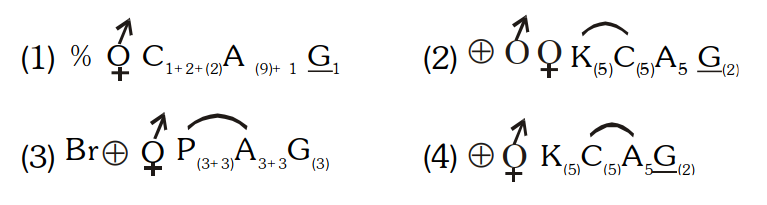
Which of the following is the correct floral formula of Liliaceae ?
AI-generated explanation. Check against your textbook.
Explanation:
NCERT states that Liliaceae flowers are trimerous (three petals and three sepals, often indistinguishable as tepals), with six stamens, and a single, superior ovary. The floral formula is thus K(3) C(3) A(6) G(1) with the ovary superior. The correct option among the given choices is therefore option 3, which represents this pattern. Distinguish from options showing inferior ovary (G with a parenthesis or I indicating inferior), or from those indicating zygomorphy or a different stamen count; those do not match Liliaceae’s NCERT description.
🧠 Did You Know?
In Liliaceae, the perianth segments are usually similar in appearance (tepals), making calyx and corolla indistinguishable in the floral formula.
Placentation in which ovules develop on the inner
wall of the ovary or in peripheral part, is:
AI-generated explanation. Check against your textbook.
Explanation:
Parietal placentation is described as ovules developing from the inner wall or peripheral part of the ovary. In this type, placentation occurs on the walls of an ovary that may be unilocular or divided but with ovules attached to the walls. This matches option 4. Other options: basal placentation has a single ovule at the base; axile placentation places ovules along a central axis in a multi-chambered ovary; free central placentation has ovules on a central fold with no central septum.
🧠 Did You Know?
Parietal placentation is common in many dicot plants and is often seen in peppers and mustard family flowers.
AI-generated explanation. Check against your textbook.
Explanation:
Persistent nucellus in the seed is called perisperm. In some seeds, the nucellus remains as a food reserve and forms the main part of the seed’s nutritive tissue, instead of developing into endosperm.
🧠 Did You Know?
Perisperm is seen in seeds of some plants like certain types of peppers and black pepper, where the nucellus does not degenerate.
💡 NCERT Memory Line:
Persistent nucellus = perisperm; chalaza, hilum, and tegmen refer to other parts: chalaza (attachment region), hilum (seed scar), tegmen (outer seed coat layer).